
Copeland Scroll Compressors
- FYI #245
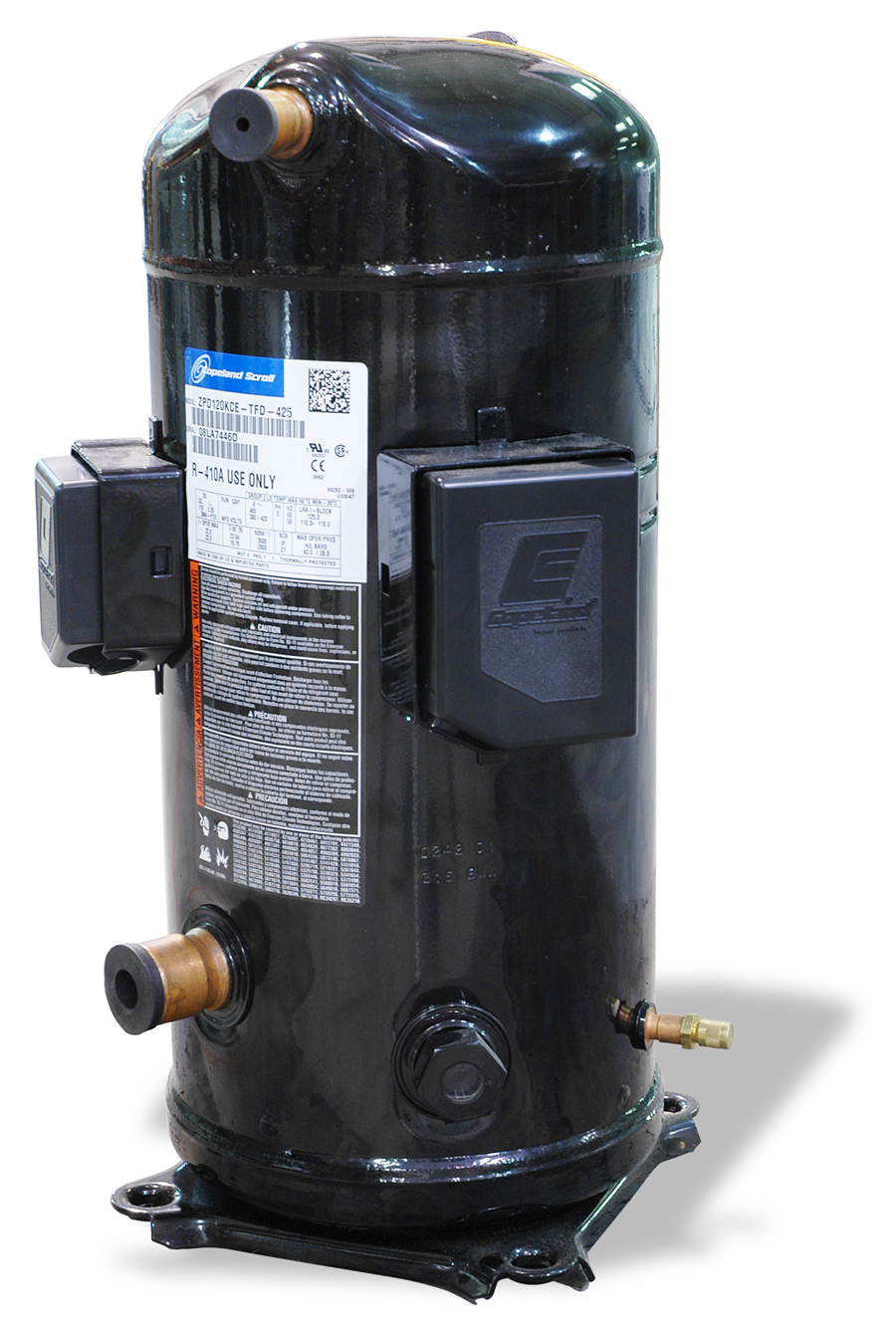
Copeland Scroll compressors are used on most Advantage portable and central water chillers, from 3 to 90 tons, air cooled and water cooled units.
- Copeland Scroll compressors have several benefits over other types of compressors. Scroll Compressors…
- Have only three moving parts. Fewer moving parts mean increased reliability. By comparison, piston compressors have up to nine moving parts per cylinder. Benefit: fewer maintenance calls.
- Do not use complex internal suction and discharge valves. Because of this, scroll compressors are more tolerant to liquid refrigerant and debris. Benefit: durability.
- Are more efficient over their entire operating range, thanks to less cycling and 100% volumetric efficiency. Benefit: higher efficiency.
- Are compact in overall size, are light weight, and are simple in design. Benefit: easy service and maintenance.
- Operate at a lower sound and vibration levels. Benefit: quiet operation.
Operational sequence of Scroll Compressors
Step 1

Refrigerant enters outer opening as one scroll orbits the other.
Refrigerant enters outer opening as one scroll orbits the other.
Step 2

The open passage is sealed and refrigerant is drawn into the compression chamber.
The open passage is sealed and refrigerant is drawn into the compression chamber.
Step 3

As one scroll continue orbiting, the refrigerant is compressed into an increasingly smaller, crescent-shaped pocket.
As one scroll continue orbiting, the refrigerant is compressed into an increasingly smaller, crescent-shaped pocket.
Step 4

By the time the refrigerant reaches a central port in the stationary scroll, it has achieved maximum (discharge) pressure.
By the time the refrigerant reaches a central port in the stationary scroll, it has achieved maximum (discharge) pressure.
Step 5

During actual operation, all passages are in various stages of compression at all times, resulting in near-continuous intake and discharge for optimum performance.
During actual operation, all passages are in various stages of compression at all times, resulting in near-continuous intake and discharge for optimum performance.
Download the PDF document
Download PDF