
Industrial Portable Process Water Chillers Built for Performance
Key Technical Specifications
- Cooling Capacity: ¼ – 40 tons (.9 kW – 140 kW)
- Temperature Range: 20 °F – 80 °F fluid temperatures
- Refrigerants: Low-GWP R-454B and R-513A
- Configurations: Air-cooled, water-cooled, remote-condenser
- Pump Capacities: ⅓ to 7.5 horsepower, .6 gpm to 92 gpm (depending on model)
- Power Options: 115 & 208 Volt Single phase and 230, 460 & 575 Volt 3-phase service (depending on models)
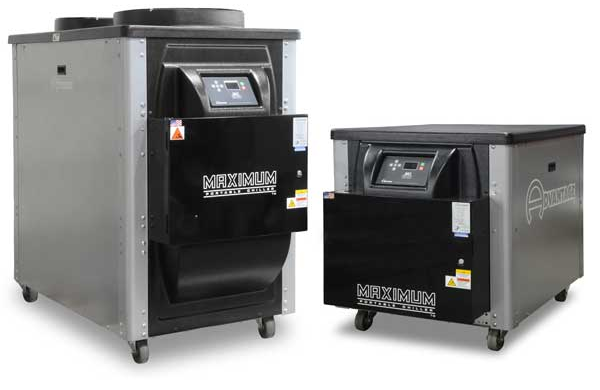
Which Model Best Fits Your Application?
Choose from three configurations — air-cooled, water-cooled, or air-cooled with remote condenser — to fit your process and installation needs. Every Advantage design delivers the same proven reliability and energy-efficient operation.
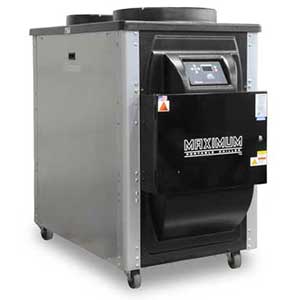
Air-Cooled Portable Chillers (1/4 to 30 Tons)
- Self-contained; no plant water loop required
- Heat rejected to ambient air
- Compact footprint for machine-level cooling
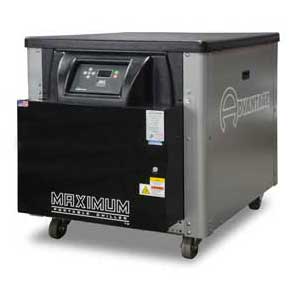
Water-Cooled Portable Process Chillers (2 to 40 Tons)
- Uses plant water (cooling tower or closed-loop supply) for condenser cooling
- Stable operation at higher ambient temperatures
- Lower condenser energy use and quieter operation
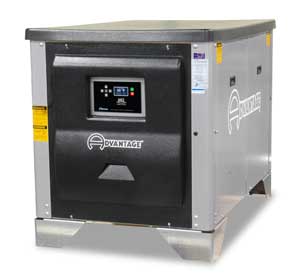
Remote Condenser Portable Process Chillers (5 to 40 Tons)
- Heat rejection moved outdoors via remote condenser
- Reduces heat and noise on the production floor
- Ideal for tight or temperature-sensitive production areas
Why Choose a Portable Process Chiller Instead of a Central System?
Portable process chillers give you the freedom to cool exactly where you need it. Each unit delivers its own setpoint and cooling capacity, eliminating the engineering and piping requirements of a central system. As your production changes, portable units can be moved or reassigned in minutes; perfect for maintenance downtime, seasonal shifts, or new machine installations.
- Consistent Performance: Stable flow and temperature unaffected by other machines.
- Built-In Redundancy: A single unit issue only affects one process, not the whole plant.
- Fast & Simple Setup: Shorter lead times, quick installation—just power and hoses.
- Flexible & Customizable: Choose air- or water-cooled, add bigger pumps or special features easily.
- Local Process Insight: Onboard controls give real-time temperature, pressure, and flow data at the use point.
- Energy Efficiency: Modern compressors and control systems adjust to load and cut power use.
- Easy to Expand: Add a new machine and chiller—no need to rework central piping.
- Lower Upfront and Operating Costs: Often less expensive to buy and install. No long piping runs or central system losses.
- Simpler Maintenance: Smaller, less costly components and less specialized service required.
- Plug-and-play design: No external reservoir or pumps required.
- Rapid setup gets you running fast: No complex piping or long installation schedules like central systems.
- Independent machine control: For consistent part quality.
- Ideal backup during central system maintenance or upgrades.
- Compact footprint: Maximizes space around equipment.
Whether you’re cooling an EDM machine, plastic molding press, or chemical tank, Advantage Portable Chillers keep production steady and repeatable.
How Do Advantage Portable Process Chillers Simplify Operation and Maintenance?
Every unit is engineered for ease of use on the plant floor. Portable chillers other than remote condenser models arrive factory-run tested and fully charged — ready to power up and connect to your process lines. Convenient, safe access to components streamlines maintenance.
User-Focused Features
- Digital temperature controller with process and set-point readout for precise temperature management.
- Accessible component layout — pumps, compressors, and heat exchangers are positioned for safe, efficient service.
- Industrial-duty enclosures and construction ensure long-term durability on the shop floor.
- Casters are standard for convenient mobility between machines.
- Field-replaceable components supported by a robust U.S.-based parts inventory.
Case Example: Flexible Cooling for a Tool and Die Shop
A Midwestern tool and die manufacturer needed a solution to support multiple EDM stations with independent temperature control. Advantage supplied three 2-ton MG Series air-cooled portable process chillers, each dedicated to a machine. Setup was completed in one day, and the shop achieved consistent part tolerances.
The three independent MG-Series chillers gave the shop dedicated temperature control for each EDM station, improving part consistency and tolerances. The modular setup provided built-in redundancy—if one unit requires service, the others keep production running. The modular approach allows future expansion—additional chillers can be added as new machines come online without redesigning the cooling infrastructure.
Technical Specifications
| Parameter | Range / Description |
| Cooling Capacity | 0.25 – 40 Tons (.9 kW – 140 kW) |
| Temperature Range | 20 °F – 80 °F |
| Refrigerants | Low GWP R-454B and R-513A |
| Pump Capacity | ⅓ to 7.5 horsepower, .6 gpm to 92 gpm (depending on model) |
| Power Options | 115 & 208 Volt Single phase and 230, 460 & 575 Volt 3-phase service (depending on models) |
| Configurations | Air-cooled, water-cooled, remote condenser |
| Construction | Industrial-duty enclosures and construction ensure long-term durability on the shop floor. |
| Controls | Digital temperature display / out of spec alarms |
| Testing | Fully assembled and factory run tested before shipment |
Portable Process Chiller FAQs
General & Selection
What’s the difference between air-cooled and water-cooled portable chillers?
Air-cooled models reject heat to the surrounding air and require no plant water loop.
Water-cooled models use plant water—typically from a cooling tower or closed-loop supply—to cool the condenser, providing more stable performance in warm or tightly controlled indoor environments.Can portable chillers run continuously?
Yes. Advantage portable chillers are engineered for continuous 24/7 industrial duty and use long-life components suitable for round-the-clock operation.
Can I expand capacity later?
Yes. Capacity can be scaled by replacing a unit with a larger model or adding additional portable chillers in parallel, depending on how your process is plumbed as your needs grow.
Are portable chillers suitable for indoor and outdoor use?
Most models are designed for indoor industrial environments. Certain air-cooled units may be placed near open doors or in semi-conditioned spaces, but full outdoor installation typically requires a remote-condenser model. (Always verify environmental limits in the specification sheet.)
How do I choose between a portable chiller and a central system?
Portable chillers are ideal when you need:
- Dedicated temperature control at each machine
- Fast installation without major piping
- Flexibility to move or reassign cooling capacity
- A central system is better when many machines share a common load and long-term scalability is the priority.
Installation & Operation
Do portable chillers require special installation?
No special piping or field assembly is required. Installation typically involves:
- Connecting the process supply and return lines.
- Supplying the correct electrical power.
- Filling the reservoir with water or a water/glycol mixture. No external condenser setup or permanent piping is needed.
What power requirements do portable chillers have?
Units are available in common industrial voltages, typically 230/3/60, 460/3/60, and select 575/3/60 models. Always confirm that plant power matches the unit’s nameplate before installation.
How do I determine the right capacity for my process?
Sizing is based on your heat load, desired temperature, flow rate, and ambient conditions. Share your process data with the Advantage Engineering team and we will model the correct capacity and configuration for your application.
How much noise do portable chillers produce?
Air-cooled units generate condenser fan noise, while water-cooled models are typically quieter since the condenser is water-cooled. Remote-condenser models place noise outdoors and keep production areas more comfortable.
What temperature range can portable chillers operate in?
Portable chillers typically maintain outlet temperatures from 20°F up to 80°F, depending on model, refrigerant, and ambient conditions. Always check the unit’s specification for exact limits.
Maintenance & Service
How are portable chillers maintained?
Routine maintenance includes:
- Cleaning strainers or filters
- Inspecting pump operation and flow
- Checking refrigerant pressures
- Verifying electrical connections
Where can I get replacement parts?
Advantage stocks U.S.-based inventory for pumps, controls, heat exchangers, and other field-replaceable components. Most parts ship quickly.
How long do portable chillers typically last?
With routine maintenance, portable chillers commonly operate 10–20+ years depending on usage, environment, and service practices. Many Advantage units remain in operation well beyond these ranges.
Not Sure Which Portable Process Chiller You Need? We Can Help.
Share your process details with our application team and we’ll recommend the correct capacity and configuration for your operation—fast, accurate, and with no guesswork.