Process Cooling · Decision Framework

Central vs. Portable Chillers: A Decision Framework

Most comparisons stop at a feature checklist. This one goes straight to the decision — matching the right system to your load profile, process temperatures, floor layout, and maintenance bandwidth.
Advantage Engineering

11 min read

Industrial Process Cooling

Portable Units
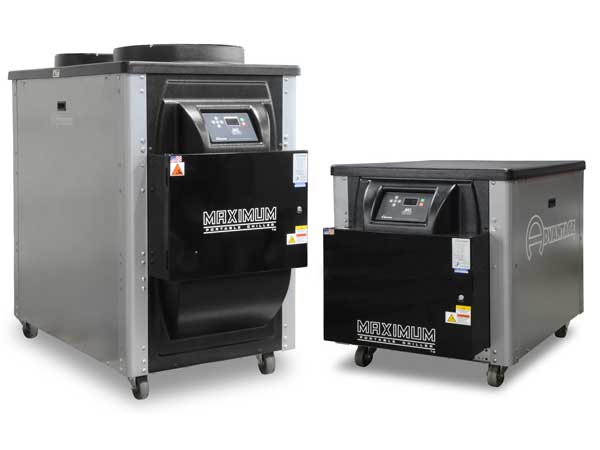
Two MAXIMUM-series portable process chillers
MAXIMUM™ portable process chillers — 1 to 40 tons, self-contained

The question comes up constantly in mid-market manufacturing plants: should you run portable chillers at each machine, consolidate everything into a central system, or do some combination of both?

Most of the content on this topic stops at a surface-level feature comparison and leaves you to figure out the hard part yourself. This article skips the obvious and goes straight to the decision framework.

The right answer depends on your cooling load profile, your process temperature requirements, your floor layout, your maintenance bandwidth, and your tolerance for single-point failure. Get those factors wrong and you’ll either overpay on energy costs for years — or find yourself troubleshooting a plant-wide cooling failure at 2 a.m. on a Tuesday.

50–250

Before you read further

This framework is built around plants in the 50–250 employee range running 10 to 150+ tons of total cooling load. Outside that range, some thresholds shift — but the diagnostic logic stays the same.

A The Mechanics

How Each System Actually Works

Understanding the mechanical difference matters because it directly explains the trade-offs you’ll face in cost, maintenance, and failure risk.

Portable process chiller

Portable Chillers

Self-contained, on casters, machine-side

Compressor, condenser, evaporator, process pump, and reservoir all in one unit. It sits next to the machine it serves, connects via flexible hoses, and runs independently. If it goes down, one process stops — everything else keeps running. Units are sized for the largest load that machine will ever see, so they often run at partial load.

1–40Tons / unit
1Process served

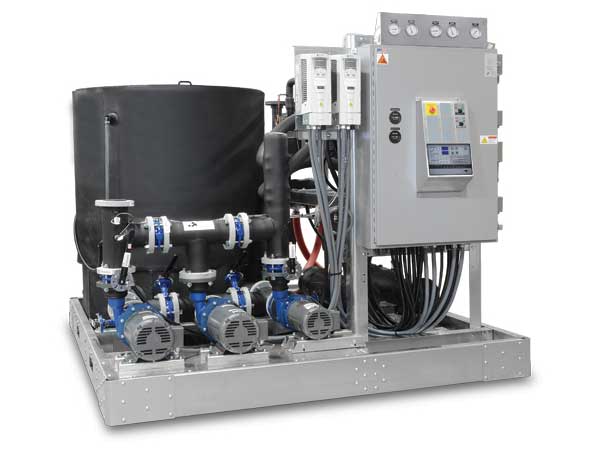
Central water chiller skid

Central Chillers

Plant-level system feeding a distribution loop

A plant-level refrigeration system that feeds a loop serving many machines at once. The chiller lives in a mechanical room or outdoors; process water circulates through insulated supply and return mains. Its key advantage is load diversity — when one line runs lighter, the chiller unloads to match demand.

10–250+Tons / system
ManyProcesses served

Key distinction

A portable chiller is sized for one machine’s peak load. A central chiller is sized for the statistical peak of many machines running simultaneously — almost always less than the sum of individual peaks. That’s where the efficiency math starts working in central’s favor.

B Total Cost of Ownership

Upfront Price vs. What You Actually Pay

This is where most buying decisions go sideways. Plants compare purchase price and stop there. The actual cost picture looks very different once you factor in installation, energy, and maintenance labor over a 10-year horizon.

Equipment & installation

Portable chillers have a lower per-unit price but a higher per-ton cost when you’re buying multiple units to cover a full plant. A 10-ton portable runs roughly $12,000–$13,000 per unit — nine of them, about $115,000 in equipment alone. A 90-ton central system serving the same load runs closer to $75,000 in equipment, though piping, insulated mains, a pumping skid, and controls add $20,000–$60,000 depending on layout.

The crossover point

Once you’re cooling more than four or five machines with similar temperature requirements, the total installed cost of a central system typically comes out below the equivalent portable fleet.

Energy

Portable chillers are sized for peak load and typically use hot-gas bypass to shed excess capacity — meaning they draw near-rated power even when actual demand is half that. Central chillers use staged scroll compressors, unloadable screw compressors, or variable-speed drives to modulate output to real demand.

25–30%

Typical energy savings

Central chillers with staged scroll or screw compressors typically save 25–30% in energy versus an equivalent portable fleet — oil-free centrifugal designs can reach 50%+. On a 90-ton system at $0.12/kWh and 6,000 hrs/yr, that 30% reduction is roughly $15,000–$20,000 a year.

Maintenance labor

Maintenance labor scales directly with unit count. A nine-unit portable fleet requires roughly nine times the inspection frequency of a single central system — measurable in hours per month for a three-person maintenance team.

Factor Portable Fleet (9 units) Central System (1 unit)
Units requiring PM 9 1
Filter changes / year 9× 1×
Refrigerant checks 9× 1×
Compressor monitoring points 9 1–3 (staged)
Failure isolation Per machine Plant-wide risk
Spare parts inventory Higher (9 sets) Lower (1 system)

C When Portable Wins

Choose Portable When…

Central systems win on total cost of ownership in most high-volume, stable production environments. But portable chillers are the better answer in several real-world scenarios that don’t fit that profile.

Processes need different supply temperatures

A central loop delivers one temperature to all machines. If A needs 45°F and B needs 60°F, portables let each process run at its own setpoint without expensive zone controls.

Your production layout changes frequently

Job shops and facilities that reconfigure lines benefit from flexibility. Moving a portable takes a few hours; rerouting central piping takes weeks and capital.

Total load is under 20–30 tons, fewer than four machines

Below this threshold, central installation rarely pencils out. Equipment savings don’t offset the piping and infrastructure investment.

A single process has a unique fluid requirement

Some applications need glycol concentrations, pressures, or flow rates well outside the rest of the plant. A dedicated portable handles it without complicating the central loop.

You’re adding capacity to a plant with no central loop

Retrofitting central distribution into a running facility is expensive and disruptive. A portable unit can be operational in a day.

D When Central Wins

Choose Central When…

Central systems earn their higher upfront cost when the production environment matches the conditions they’re designed for. The efficiency and maintenance advantages compound over time — but only if the application fits.

80%+ of processes run within a ±5°F range

The practical threshold. When machines all need roughly the same supply temperature, a central loop delivers uniform conditions to every point of use with no per-unit management.

You’re cooling five or more machines simultaneously

At this scale the load-diversity effect kicks in, equipment cost per ton drops below portable, and the maintenance labor savings become significant.

Floor space is constrained

Portables occupy production floor next to each machine. Central moves all refrigeration to a mechanical room or outdoors, reclaiming that area for production.

You’re building new or doing a major expansion

New construction is the lowest-cost window to install central distribution. Running mains during construction costs a fraction of a retrofit into an operating plant.

Uptime is non-negotiable and you can design in redundancy

A properly specified central system includes standby pumps and, in critical applications, a redundant compressor circuit — failover that’s faster than rolling a spare portable into position mid-run.

The honest trade-off

A central system concentrates your failure risk. Without designed-in redundancy, if the chiller goes down the whole plant stops. That’s not a reason to avoid central — it’s a reason to specify it correctly from the start.

E The Third Option

When a Hybrid Makes More Sense Than Either

The either/or framing is a false choice for a significant number of plants. A hybrid — a central system handling the bulk load while portable units serve specific outlier processes — is often the most practical, cost-effective answer.

Consider a plastics injection facility running 12 presses. Ten run standard resins at 50°F; two run a specialty material needing 38°F for tight dimensional control. A single central loop at 50°F serves the majority efficiently, while two dedicated portables at 38°F handle the specialty presses — instead of running the entire central system colder than it needs to be.

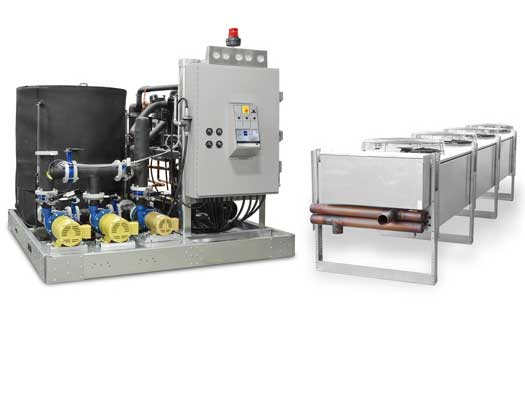
Central chiller skid with remote condenser bank
Central packaged system with remote condenser — the base-load workhorse in a hybrid plant

Consider hybrid when…

  • One or two processes need temperatures more than 10°F outside your main range — serve the outliers with portables and let central run at its most efficient setpoint.
  • You’re transitioning from a portable fleet to central infrastructure — portables stay in service on outliers or as backup while central handles base load.
  • You have a high-priority process that can’t share a failure event with the rest of the plant — a dedicated portable provides isolation.

Application Specialist note

In 40+ years of installations, hybrid configurations are underused. Plants tend to make an all-or-nothing decision when the data supports a split. If your process temperature map shows more than a 10–15°F spread, model a hybrid before committing to either extreme.

The Decision Framework

Four Questions to Ask Before You Specify

Run through these in order. The answers point you to the right configuration — no thermal engineering degree required.

What is your total cooling load, and how many machines share it?

Under 20–30 tons across three or fewer machines — portable is almost always right. Above 40 tons across five or more — central starts making financial sense. Between those, run the numbers on both.

Do your processes require different supply temperatures?

Map the required temperature for each machine. If 80%+ fall within a ±5°F band, central is viable. Significant spread — plan for a hybrid or stay with portables.

How stable is your production layout?

If your floor plan changes quarterly, portable wins on flexibility. If the layout has held for five years and won’t change, the inflexibility of central piping isn’t a real constraint.

What is your actual maintenance bandwidth?

Be honest. A portable fleet of eight units needs eight times the PM attention of one central system. If your team is already stretched, more units to manage is a real operational cost — even if the purchase price looks lower.

Scenario Portable Central Hybrid
Total load under 30 tons Best fit Oversized Rarely needed
5+ machines, same temp Higher long-term cost Best fit If outliers exist
Mixed temperature needs Best fit Needs zone controls Best fit
Changing floor layout Best fit Poor fit Partial fit
Maintenance bandwidth limited Higher labor Lower labor Moderate
New construction / expansion Either Best fit Either

The Bottom Line

There is no universally correct answer.

The right system is the one matched to your actual load profile, temperature requirements, layout stability, and maintenance capacity. What’s clear: the plants that get this wrong almost always do so by choosing on purchase price alone.

A portable fleet that looks cheaper on a purchase order can cost significantly more in energy and labor over five years. A central system that looks efficient on paper can become an operational liability if it’s specified without redundancy or dropped into a facility with highly variable temperature requirements.

The spec that matters most

It isn’t the chiller’s rated capacity. It’s whether the system you’re buying matches the actual operating conditions of your plant.

Tell us about your project

Get a second set of eyes on your cooling data.

Bring us your cooling load data, process temperature map, or layout constraints and an Advantage Application Specialist will tell you straight whether portable, central, or hybrid makes sense — including the cases where you don’t need what you think you need. We’ve been sizing and building industrial chillers in Greenwood, Indiana since 1977.


Talk to an Application Specialist